
Sum of Even Numbers
In this problem, you will learn how to iterate through a list of numbers and apply a condition to filter out specific elements before performing an aggregation. This is a fundamental concept in programming, often used in data processing and analysis.
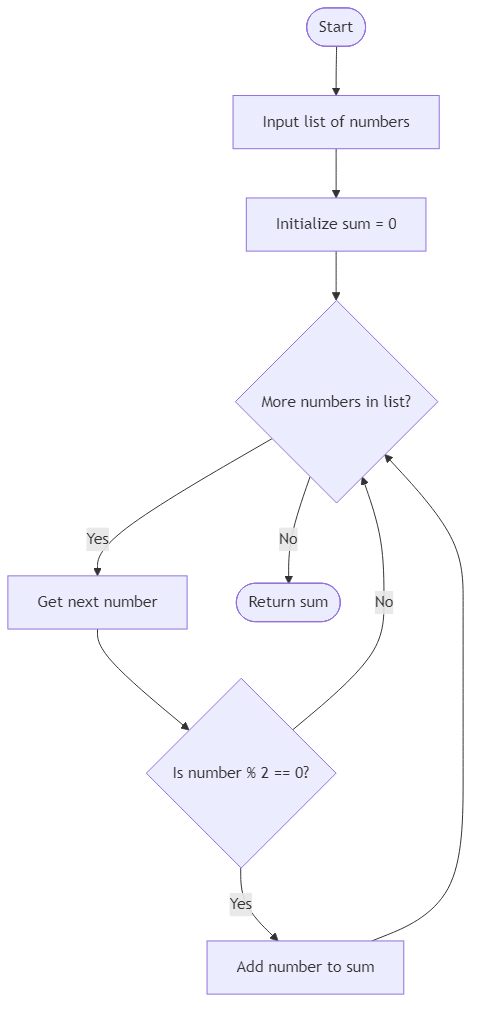
Your task is to write a function that takes a list of integers as input. The function should iterate over each number in the list, determine whether it is an even number, and if so, add it to a running total. Finally, the function should return the total sum of all the even numbers it encountered.
You can approach this problem in a few ways. You might use a simple for loop with an if statement, or you might employ more advanced Python features like list comprehensions combined with the built-in sum() function for a more concise and idiomatic solution.
Example 1:
Input: numbers = [1, 2, 3, 4, 5, 6]
Output: 12
Explanation: The even numbers in the list are 2, 4, and 6. When we add them together (2 + 4 + 6), the sum is 12.
Example 2:
Input: numbers = [1, 3, 5, 7, 9]
Output: 0
Explanation: There are no even numbers in the input list. Therefore, the sum is 0.
Example 3:
Input: numbers = [-2, -4, 5, 7, 10]
Output: 4
Explanation: The even numbers are -2, -4, and 10. Their sum is -2 + -4 + 10 = 4.
Constraints:
- The lengths of the
numberslist will be between 0 and 1000. - Each element in the
numberslist will be an integer between -10000 and 10000.
Algorithm Flow
Best Answers
def sum_even_numbers(numbers):
    # Approach 1: Generator expression within continuous sum
return sum(n for n in numbers if n % 2 == 0)Comments (0)
Join the Discussion
Share your thoughts, ask questions, or help others with this problem.