
Sort Items by Custom Criteria
Learn Python lambda functions to write concise, inline operations for sorting, filtering, and transforming data. Lambda functions are anonymous functions perfect for short operations passed as arguments to higher-order functions.
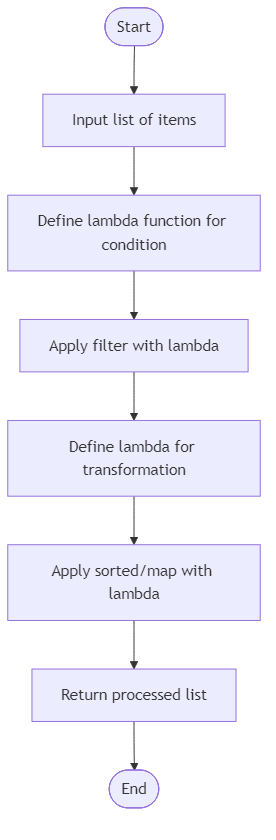
You will use lambdas with built-in functions like sorted, filter, and map to process data efficiently. The key is knowing when to use lambdas versus regular functions for maximum code clarity.
Example 1:
Input: numbers = [3, 1, 4, 1, 5, 9, 2]
Output: [1, 1, 2, 3, 4, 5, 9]
Explanation: Sort numbers in ascending order using sorted() with default comparison.
Example 2:
Input: words = ["apple", "pie", "a", "be"]
Output: ["a", "be", "pie", "apple"]
Explanation: Sort by length using lambda as key function.
Example 3:
Input: numbers = [1, 2, 3, 4, 5, 6]
Output: [2, 4, 6]
Explanation: Filter even numbers using lambda predicate.
Algorithm Flow
Best Answers
def sort_and_filter(items):
    get_value = lambda x: x[1]
return sorted(items, key=get_value)Comments (0)
Join the Discussion
Share your thoughts, ask questions, or help others with this problem.