
Combine Lists with Zip
One of the most uniquely Pythonic ways to process data is using the built-in zip() function. It elegantly pairs elements from two or more iterables, acting like a real physical zipper!
Instead of focusing on a complex loop algorithm here, your goal is to learn how to create a dictionary in the most efficient Pythonic way, given two lists: one containing the keys and the other containing the values.
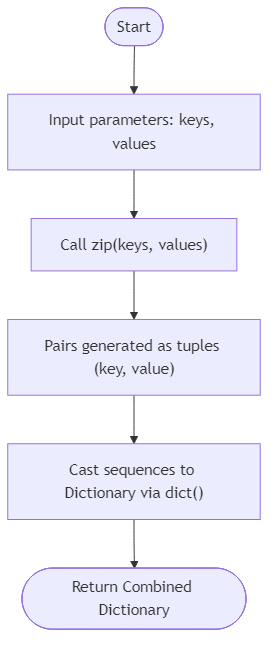
While you could initialize an empty dictionary and use a traditional for loop with range(len(keys)), Python allows you to achieve this in a single, readable, and robust line of code using dict(zip(keys, values)) or a dictionary comprehension.
Example 1:
Input: keys = ["name", "age"], values = ["Alice", 25]
Output: {"name": "Alice", "age": 25}
Example 2:
Input: keys = [1, 2, 3], values = ["one", "two", "three"]
Output: {1: "one", 2: "two", 3: "three"}
Constraints:
- Both lists will always be of the exact same length.
- The lists can be empty. If both are empty, return an empty dictionary.
Algorithm Flow
Best Answers
def combine_lists(keys, values):
    # Approach 1: Extremely Pythonic dict() casting paired with zip()
return dict(zip(keys, values))Comments (0)
Join the Discussion
Share your thoughts, ask questions, or help others with this problem.