Conveyor Batch Sequence
Imagine you’re overseeing a high-tech factory where items are moving along a conveyor belt, each with its own weight. Your mission in Conveyor Batch Sequence is to take a raw list of these weights and organize them into a perfectly ordered sequence, from lightest to heaviest. This ensures that the machinery down the line can process everything smoothly without any jams!
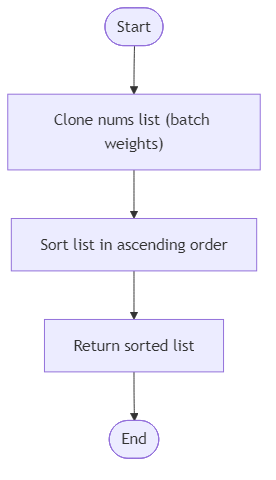
The "secret sauce" here is Ascending Sorting. In many systems, you’ll encounter duplicate weights from identical batches or even negative numbers that act as internal markers. Your solution must preserve every single one of these values while rearranging them in a clean, climbing order. To keep your system robust, you must also ensure that the original "input feed" remains untouched—always return a brand-new sorted list for the next stage of production.
This is a fundamental skill for managing sequence data. Whether you're handling inventory logs or sensor readings, mastering this sorting and non-destructive transformation is a basic building block for any software engineer!
Examples
Duplicate weights remain while the list climbs from lightest to heaviest.
An empty feed results in an empty ordered list.
Negative markers and positive weights are preserved in ascending order.
Algorithm Flow

Best Answers
import java.util.*;
class Solution {
public int[] conveyor_batch_sequence(int[] nums) {
int[] result = nums.clone();
Arrays.sort(result);
return result;
}
}Comments (0)
Join the Discussion
Share your thoughts, ask questions, or help others with this problem.