
Remove Duplicates from Sorted Array
You are given a sorted array of integers. Your task is to remove all duplicate elements so that each value appears only once while maintaining the original sorted order. The function should modify the array in place and return the count of unique elements.
After processing, the array should contain only unique numbers in ascending order at the beginning. The remaining part of the array (beyond the returned count) can contain any values and will not be considered. This means you only need to ensure that the first part of the array holds all unique elements in order.
Imagine you are organizing a list of numbers that were already sorted, but some entries were accidentally repeated. You must carefully remove the extra copies while keeping one instance of each number. It’s similar to cleaning up a roster that contains duplicate names—you don’t want to change the order, only ensure every item is unique. The result should reflect the number of distinct elements that remain.
Return the count of unique elements, not the modified array itself.
Example 1:
Input: nums = [1,1,2]
Output: 2
Explanation: The unique elements are [1,2].
Example 2:
Input: nums = [0,0,1,1,1,2,2,3,3,4]
Output: 5
Explanation: The unique elements are [0,1,2,3,4].
Example 3:
Input: nums = [1,2,3,4]
Output: 4
Explanation: The array already contains unique elements.
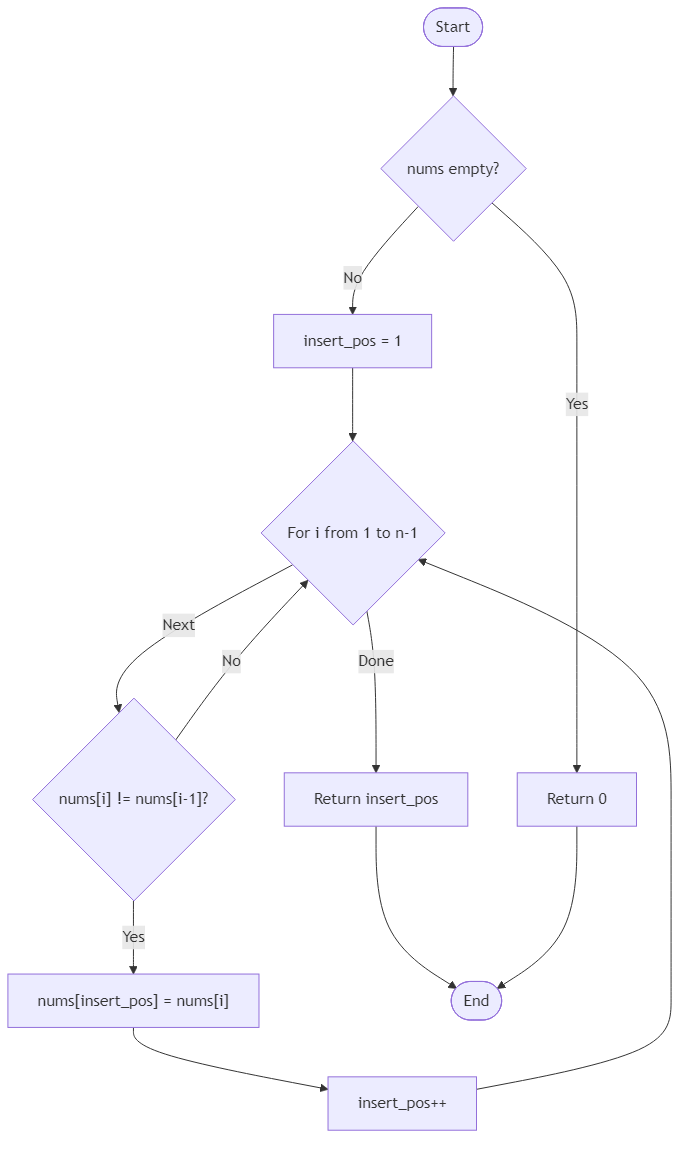
Algorithm Flow
Best Answers
class Solution {
    public int remove_duplicates(int[] nums) {
        if (nums.length == 0) return 0;
        int k = 1;
        for (int i = 1; i < nums.length; i++) {
            if (nums[i] != nums[i-1]) {
                nums[k] = nums[i];
                k++;
            }
        }
        return k;
    }
}Comments (0)
Join the Discussion
Share your thoughts, ask questions, or help others with this problem.