Top K Frequent Elements
Top K Frequent Elements requires returning the k values with highest occurrence counts in an integer array. Frequency is the only ranking signal in these tests. Output order is not strict here because the checker normalizes by sorting before comparison, but the selected set must be correct.
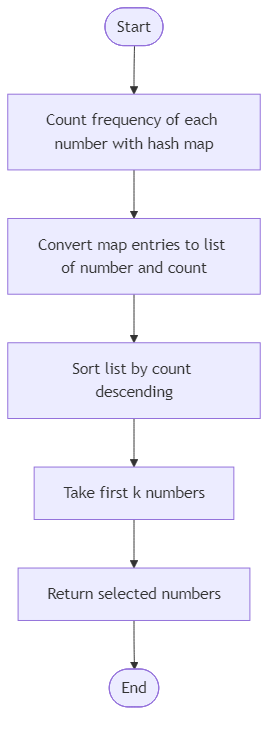
A common solution pipeline is frequency map plus selection strategy. Build counts with a hash map, then extract top-k using either a heap (efficient when k is small) or bucket grouping by frequency (linear-time style). Both approaches are valid if they return exactly k elements that correspond to highest frequencies.
Judge cases include single-element arrays, dominant repeated values, and mixed distributions where the second-best frequency matters. Return an integer array containing the selected values only. Be careful with ties: if multiple values share the cutoff frequency, any selection acceptable under test assumptions should still satisfy normalized comparison. This problem is primarily about accurate counting and controlled extraction rather than full sorting of every unique value.
If you use heap selection, ensure the comparison key is frequency, and keep extraction logic synchronized with map counts so no stale frequency record survives. The final result may be emitted in any order for this checker, but it must contain exactly the intended top-frequency value set.
Examples
1 appears 3 times, 2 appears 2 times.
Only one element exists.
4 and 5 are the two most frequent values.
Algorithm Flow

Best Answers
import java.util.*;
class Solution {
public int[] top_k_frequent_elements(int[] nums, int k) {
Map<Integer, Integer> freq = new HashMap<>();
for (int x : nums) freq.put(x, freq.getOrDefault(x, 0) + 1);
List<Map.Entry<Integer, Integer>> arr = new ArrayList<>(freq.entrySet());
arr.sort((a, b) -> b.getValue() - a.getValue());
int[] res = new int[k];
for (int i = 0; i < k; i++) res[i] = arr.get(i).getKey();
return res;
}
}Comments (0)
Join the Discussion
Share your thoughts, ask questions, or help others with this problem.