
Happy Number
Write an algorithm to determine if a number n is happy.
A happy number is defined by repeatedly replacing the number by the sum of the squares of its digits until it equals 1. If it loops endlessly in a cycle that does not include 1, then it is not happy.
Use a hash set to detect cycles.
Algorithm Flow
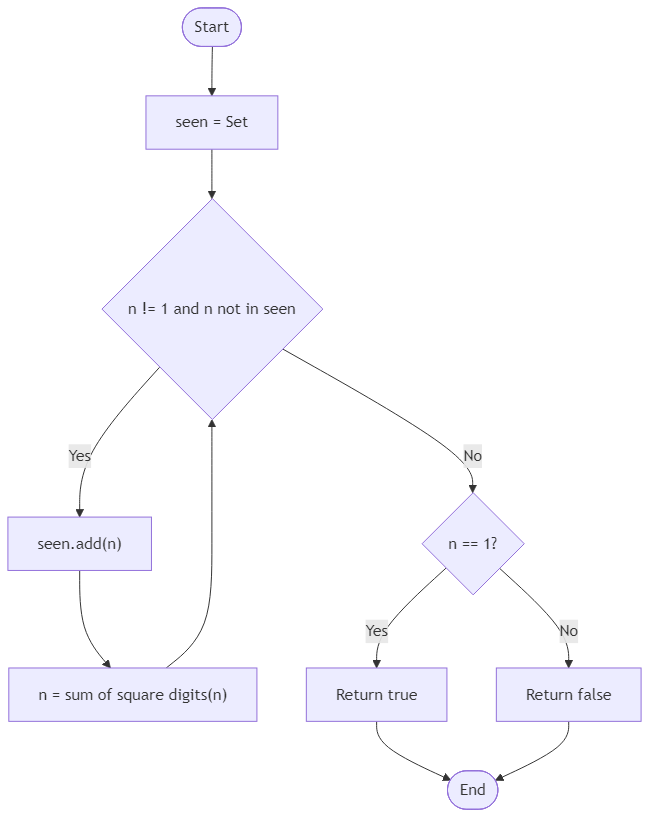
Recommendation Algorithm Flow for Happy Number - Budibadu
Best Answers
java
import java.util.*;
class Solution {
    public boolean happy_number(int n) {
        Set<Integer> seen = new HashSet<>();
        while (n != 1 && !seen.contains(n)) {
            seen.add(n);
            int total = 0;
            while (n > 0) {
                int d = n % 10;
                total += d * d;
                n /= 10;
            }
            n = total;
        }
        return n == 1;
    }
}Comments (0)
Join the Discussion
Share your thoughts, ask questions, or help others with this problem.