
Even Numbers as String
You are compiling a weekly report that highlights the even-numbered entries recorded in customer logs. The list you receive contains both even and odd integers, representing a mix of account updates and informational notes. Only even values correspond to processed transactions, and your job is to pull them out in the order they appear, formatting the final output as a comma-separated string. If no even numbers exist, return an empty string to indicate that no qualifying transactions were found.
Visualize the array as a row of numbered envelopes sorted by the time they were handled. Even-numbered envelopes hold important invoices, while odd-numbered envelopes hold general messages. As you scan the row, you collect the invoice envelopes and arrange their numbers in a line, separated by commas so the accounting team can read them quickly. The order must remain intact, preserving the chronological sequence in which the invoices were processed.
When the array is empty, the result should naturally be an empty string. Duplicates are allowed, and negative even numbers should also appear in the final string because they represent adjustments or refunds. This challenge emphasizes filtering and formatting: you must carefully select the even values and present them in a clean, human-readable format that captures the essence of the transaction list.
Example 1:
Input: nums = [1,2,3,4]
Output: "2,4"
Explanation: Only 2 and 4 are even, so the string becomes "2,4".
Example 2:
Input: nums = [5,7,9]
Output: ""
Explanation: No even numbers exist, so return an empty string.
Example 3:
Input: nums = [0,-2,8,11,14]
Output: "0,-2,8,14"
Explanation: Collect the even values while keeping their order.
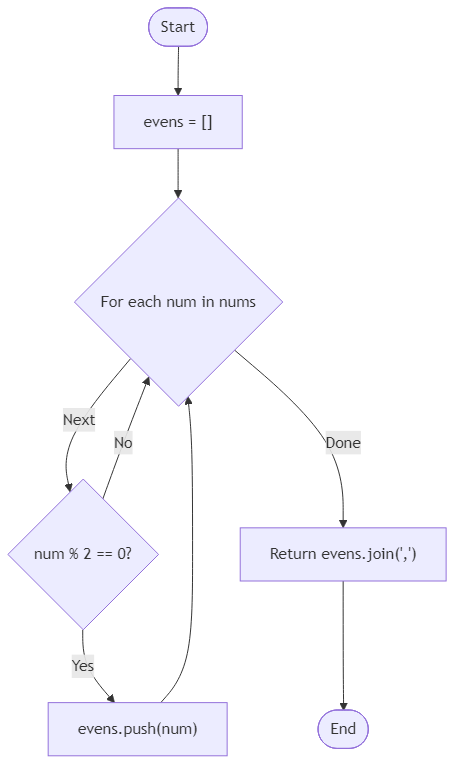
Algorithm Flow
Best Answers
import java.util.stream.*;class Solution{public String even_to_string(Object n){int[]a=(int[])n;return IntStream.of(a).filter(x->x%2==0).mapToObj(String::valueOf).collect(Collectors.joining(","));}}Comments (0)
Join the Discussion
Share your thoughts, ask questions, or help others with this problem.