
Find Target Range
You are given a sorted list of integers arranged in ascending order and a target value. Your task is to find the first and last positions of that target in the list. If the target value does not exist in the list, return [-1, -1].
This challenge focuses on reasoning about the presence and boundaries of a value within a sorted sequence. Imagine you are searching through a list to find where a certain number begins and ends — like locating a group of identical items in a sorted row. Even if the number appears only once, both its starting and ending positions are the same index.
When the target does not appear at all, both the starting and ending indices should be -1. This problem helps develop an understanding of locating boundaries in ordered data while respecting sequence consistency and index logic.
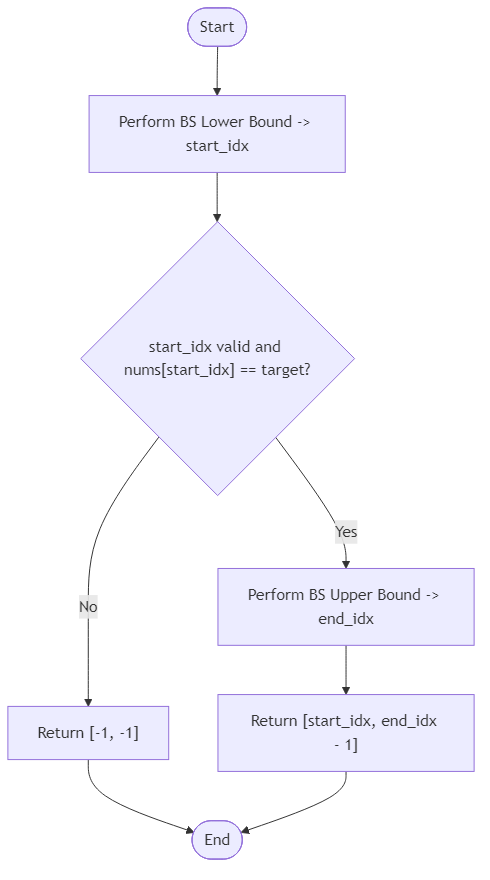
Algorithm Flow
Best Answers
import java.util.Arrays;

class Solution {
    public int[] find_target_range(int[] nums, int target) {
        int first = findBound(nums, target, true);
        if (first == -1) return new int[]{-1, -1};
        int last = findBound(nums, target, false);
        return new int[]{first, last};
    }

    private int findBound(int[] nums, int target, boolean isFirst) {
        int l = 0, r = nums.length - 1;
        int bound = -1;
        while (l <= r) {
            int mid = l + (r - l) / 2;
            if (nums[mid] == target) {
                bound = mid;
                if (isFirst) r = mid - 1;
                else l = mid + 1;
            } else if (nums[mid] < target) {
                l = mid + 1;
            } else {
                r = mid - 1;
            }
        }
        return bound;
    }
}Comments (0)
Join the Discussion
Share your thoughts, ask questions, or help others with this problem.