
Artisan Display Sort
The technical objective is to reorder a collection of artisan booth numbers, provided as an array of integers, into a strictly ascending sequence. This operation transforms a raw ledger into a structured list that facilitates logistical planning, crowd management, and signage generation for market coordinators.
The final output must be a new array containing all original booth numbers, including duplicates for shared collectives and negative placeholders for blocked aisles, arranged from smallest to largest. The solution should handle various input sizes, including single-entry and empty datasets, while maintaining the statistical integrity of the original records. This ensures a consistent and predictable data structure for open-market operations.
Example 1:
Input: nums = [14, 5, 12, 5]
Output: [5, 5, 12, 14]
Example 2:
Input: nums = [3]
Output: [3]
Example 3:
Input: nums = [9, -2, 4, 9]
Output: [-2, 4, 9, 9]
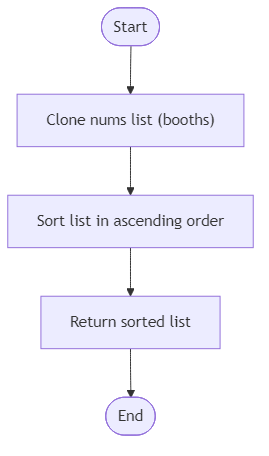
Algorithm Flow
Best Answers
import java.util.*;

class Solution {
    public int[] artisan_display_sort(int[] nums) {
        int[] sortedArr = nums.clone();
        Arrays.sort(sortedArr);
        return sortedArr;
    }
}Comments (0)
Join the Discussion
Share your thoughts, ask questions, or help others with this problem.