
Missing Seat Number
Imagine a small theater where each seat is tagged with an integer starting from 0, forming a neat sequence: 0, 1, 2, and so on. On a busy evening, a group of friends arrives, each holding a ticket that specifies their seat. When everyone files in, one seat remains oddly vacant. Your task is to determine which seat number is missing from the list of tickets. The array you are given represents the seat numbers that were actually scanned at the entrance, but it is missing exactly one label from the complete range.
This puzzle asks you to reconstruct the full picture from partial evidence. The seats in the range from 0 to n all exist, and only one is absent. Some sequences may begin with a missing 0, while others might lack the final seat labeled n. The array can appear in any order because people check in randomly. Your role is to think like the usher comparing the guest list to the actual arrivals, spotting the absent name at a glance.
When the array is empty, the missing seat must be 0. If every seat is accounted for in numerical order, your answer is the next seat that would extend the range. The challenge celebrates careful observation: by reconciling the tickets with the complete set of seat labels, you reveal the precise number that has slipped away unnoticed.
Examples
Seats 0 through 3 exist, and 2 is the missing label.
The full range is 0, 1, 2; the last seat is missing.
Among seats 0 through 9, the label 8 never appears.
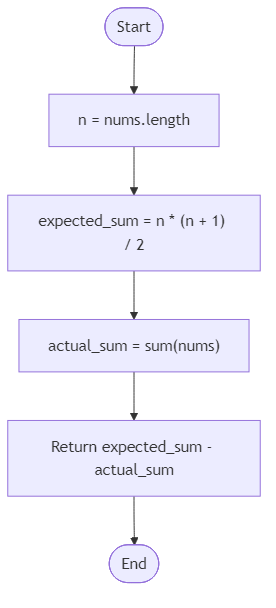
Algorithm Flow
Best Answers
class Solution {
    public int missing_number(Object nums) {
        if (nums instanceof int[]) {
            int[] arr = (int[]) nums;
            int n = arr.length;
            int expected = n * (n + 1) / 2;
            int sum = 0;
            for(int x : arr) sum += x;
            return expected - sum;
        } else if (nums instanceof java.util.List) {
            java.util.List<?> list = (java.util.List<?>) nums;
            int n = list.size();
            int expected = n * (n + 1) / 2;
            int sum = 0;
            for(Object x : list) sum += (Integer)x;
            return expected - sum;
        }
        return 0;
    }
}Comments (0)
Join the Discussion
Share your thoughts, ask questions, or help others with this problem.