
Maximum Subarray Sum
Given an array of integers, write a function to find the contiguous subarray (containing at least one number) that has the largest sum and return that sum.
Problem Details: You are provided with an array of integers, which may include both positive and negative numbers. Your task is to identify the contiguous subarray within this array that yields the maximum sum. A contiguous subarray is a sequence of numbers that are adjacent in the original array. If all numbers in the array are negative, the maximum sum will be the largest single number in the array. The solution must handle edge cases, such as an array with only one element or an array where all elements are negative. The goal is to compute the sum efficiently while ensuring correctness for all possible input cases.
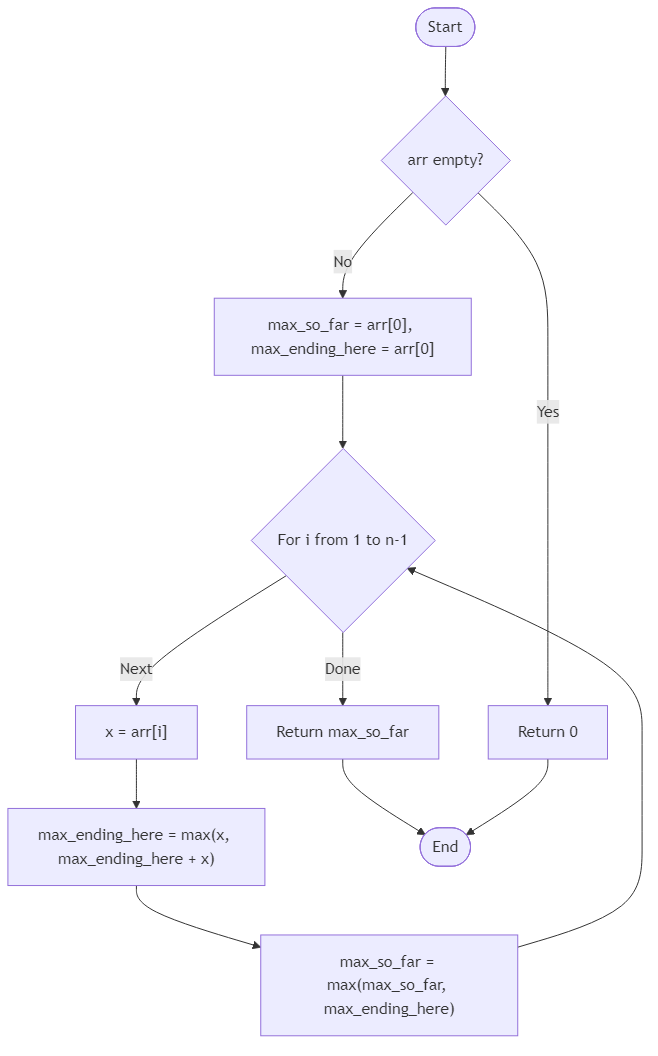
Algorithm Flow
Best Answers
class Solution {
    public int max_subarray_sum(int[] nums) {
        int maxSoFar = nums[0];
        int currentMax = nums[0];
        for (int i = 1; i < nums.length; i++) {
            currentMax = Math.max(nums[i], currentMax + nums[i]);
            maxSoFar = Math.max(maxSoFar, currentMax);
        }
        return maxSoFar;
    }
}Comments (0)
Join the Discussion
Share your thoughts, ask questions, or help others with this problem.